

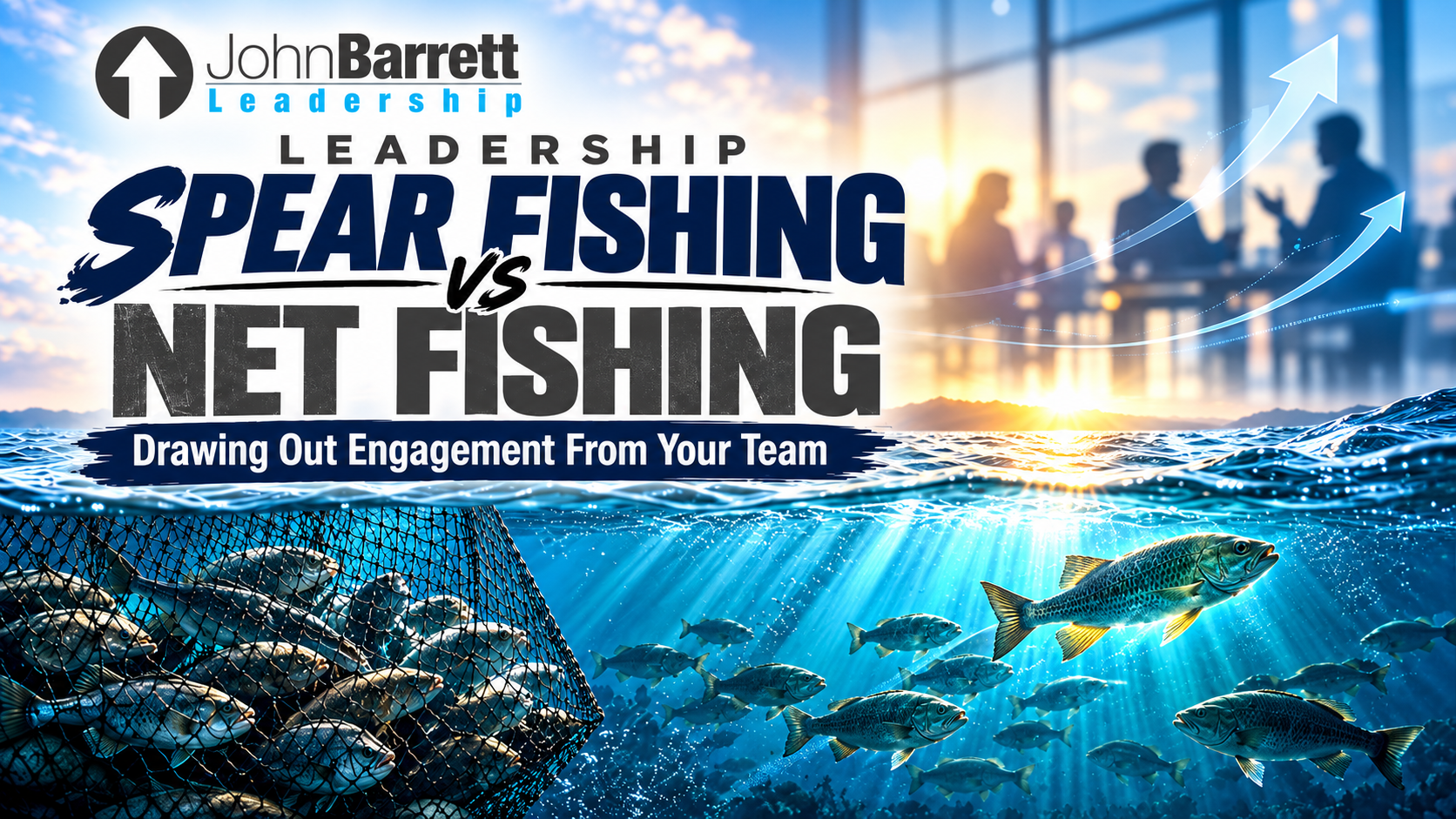
Leadership Spear Fishing vs Net Fishing: Drawing Out Engagement From Your Team
One of the greatest challenges leaders face is getting people to engage. You’ve probably experienced it before. You’re leading a meeting, you ask a great question, and then…silence. You wait, hoping someone will jump in with an answer, but no one seems willing to speak up. Or, even worse, the same two or three people dominate every conversation while everyone else sits quietly.
The problem isn’t necessarily that your team doesn’t have anything valuable to say. The problem might be how you’re trying to get them to say it.
Great leaders don’t just wait for engagement to happen. They intentionally draw it out of others.
One of the most effective ways to do this is by learning the difference between net fishing and spear fishing.
Net Fishing vs. Spear Fishing
Think about the difference between these two approaches. Net fishing involves casting a wide net and hoping something gets caught. Spear fishing, on the other hand, is intentional. You identify a specific target, focus your attention, and go after it.
The same principle applies to leadership.
Net fishing is when you throw out a question to the entire team and hope someone responds. You ask something like, “What does everyone think about this idea?” and then wait for someone to take the bait. While there’s certainly a time and place for open-ended group discussions, this approach often produces limited engagement. The naturally vocal people jump in while the quieter voices remain unheard.
Spear fishing is when you intentionally call on specific people to contribute their thoughts, ideas, and perspectives. Instead of asking the entire room what they think, you might say, “Sarah, I’d love to hear your perspective on this. What opportunities do you see?” Or, “Mike, based on your experience, what challenges should we be considering?”
This simple shift can completely change the dynamics of your meetings.
The Power Of Intentional Engagement
Great leaders understand that everyone on their team has something valuable to contribute, but not everyone will naturally volunteer it. Some people are more reserved, others need a little encouragement, and some simply don’t want to compete with the louder personalities in the room.
When you start spear fishing for engagement, you’re creating intentional opportunities for people to use their voice. You’re communicating that their perspective matters and that you value what they bring to the table.
And here’s the incredible thing: Sometimes the greatest insights come from the people who speak the least.
But you’ll never discover those insights if you’re always waiting for them to volunteer.
The goal isn’t simply to get more people talking. The goal is to extract more wisdom, creativity, ownership, and collaboration from your team. When more voices are heard, you gain more perspectives, make better decisions, and create a stronger culture of engagement.
Engagement Creates Preparation
There’s another powerful benefit to spear fishing that many leaders overlook. It creates a culture of preparation.
Too many people show up to meetings expecting to sit back, listen, and let someone else do the thinking. They’ve become comfortable being spectators rather than contributors. And sometimes, without realizing it, leaders have trained their teams to operate this way.
When you consistently and appropriately call on different people for their input, something begins to change. Your team starts realizing that participation isn’t optional or reserved for a select few. Everyone has an opportunity and responsibility to contribute.
Over time, people begin showing up more prepared, more thoughtful, and more ready to engage because they know their perspective might be invited into the conversation at any moment.
The expectation of engagement raises the level of preparation.
You’re not just developing a more vocal team. You’re developing a more thoughtful and invested team.
Don’t Call People Out, Call People Up
Now, there’s an important distinction here. Spear fishing isn’t about embarrassing people, catching them off guard, or putting them on the spot to prove a point. That’s not leadership development. That’s intimidation.
The purpose isn’t to call people out. It’s to call people up to a greater level of contribution.
Great leaders know their people well enough to understand when and how to invite them into the conversation. They create an environment where people feel safe sharing their thoughts, even when those thoughts aren’t perfectly polished.
You might even prepare your team ahead of time by letting them know you’ll be asking everyone to contribute during an upcoming meeting. This gives people the opportunity to think through their ideas before they arrive.
The key is to be intentional, encouraging, and strategic. Don’t just randomly call on people. Consider who has valuable experience, who needs an opportunity to grow, and whose voice hasn’t been heard. Sometimes the right person at the right moment can completely shift the direction of a conversation.
Remember, the goal isn’t to make people uncomfortable. The goal is to make them more capable and confident.
Start Fishing With Intention
The next time you’re leading a meeting, pay attention to how you’re drawing engagement from your team. Are you constantly throwing out a net and hoping someone responds? Are the same people doing all the talking? Are there valuable voices in the room that rarely get heard?
Start being more intentional about who you invite into the conversation. Challenge people to contribute. Encourage quieter voices. Create expectations for preparation and participation. And most importantly, make sure people know their contribution is genuinely valued.
You don’t have to abandon net fishing altogether. There are times when opening up the conversation to everyone is exactly what you need. But if you want to maximize your team’s potential, you have to know when to pick up the spear.
Great leaders don’t just create opportunities for engagement. They draw engagement out of others.
When you learn to spear fish for engagement, you’ll begin developing a team that is more prepared, more confident, more collaborative, and more willing to contribute. And over time, you’ll discover that the greatest value in your meetings isn’t just what you bring to the table, but what you’re able to bring out of everyone sitting around it.
That’s how you level up your leadership, my friend!


Leave a Reply
Your email is safe with us.